Showing posts with label Greens. Show all posts

May 10, 2026

UK Greens Crush Labour

Left-wing activist, Owen Jones, covers the extent of the Greens victory in the local elections just held in the UK. 

Owen Jones is accurate but maybe he doesn't quite understand the full extent of what happened. Labour finds itself isolated, with nowhere to call home. They've been attacked from two ends. Take voters in the North, many of whom ordinarily vote Labour. They voted Reform en masse. Then down South, the trendy champagne socialists who compost their kitchen waste and protest against Israel on the weekends, voted Greens. The breadth of the defeat is what is transformational. The new parties, no doubt, will have their struggles, but they now have a platform from which to grow. 

December 07, 2025

Reform UK and Conservatives Lead

The most recent public opinion poll in the UK:

Reform 31%

Conservatives 20%

Greens 18%

Labour (government) 14%

At this rate, if an election was held tomorrow, Reform UK and the Conservatives would likely form a coalition government.

(Pollster: Find Out Now)

November 07, 2025

UK Labour Now Fourth

How long has Keir Starmer got left? Labour in the UK are now below the Greens in the latest public opinion poll.

Pollster: Find Out Now, sample size 2717, 5-6 Nov., 2025 (government bold)

Reform UK 33%

Greens 18%

Conservatives 16% (Opposition)

Labour 15% (Government)

The top two parties are relatively new, while the bottom two are the old-school established parties. That must be significant.


November 05, 2025

New Zealand EV Sales

Don't believe the hype, EVs are toast. The subsidies have ended, and guess what, they don't stack up as a sensible purchase.


November 01, 2025

UK Political Revolution

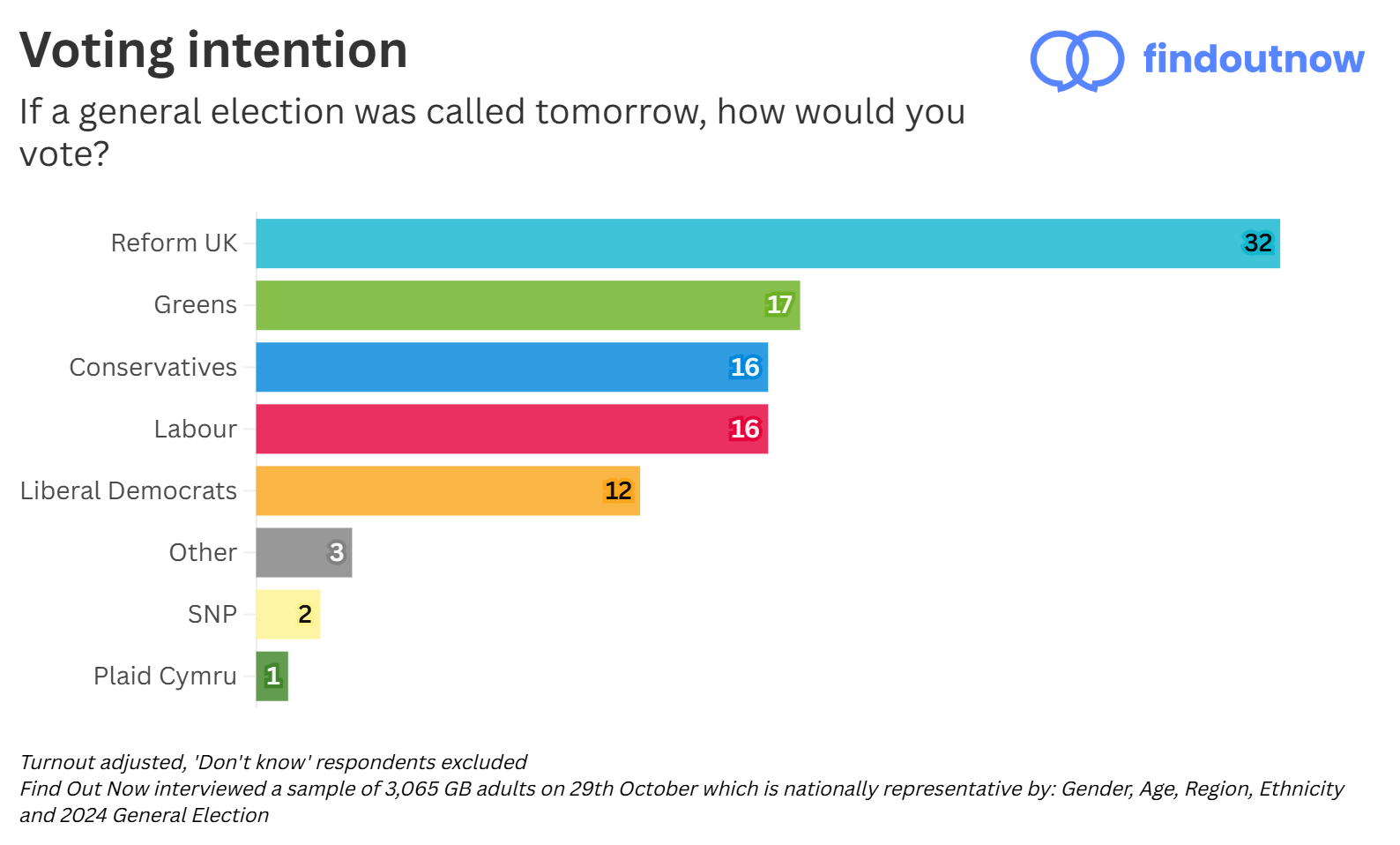
The most recent political opinion poll from Find Out Now in the UK has Reform UK on top with 32%. Significantly, the second largest party are the Greens. Then, Labour and the Conservatives are in equal third. We see two relatively new parties now displacing the two much older parties.

Keir Starmer may even struggle to win his seat if an election was held tomorrow.

Find Out Now


October 17, 2025

Major Political Shift UK

How long can UK Prime Minister, Keir Starmer, hang on? The Greens have now passed the UK Labour Party, and the Conservatives have risen to second behind Reform UK. The Government, Labour, are now in fourth place.

March 31, 2025

Benjamin Doyle NZ Greens MP

New Zealand has plumbed the depths once again. Yet another Greens MP, of course: 

https://centrist.nz/open-letter-to-nz-media-on-green-mp-benjamin-doyle/

The rest of the legacy media, who each continually claim to be trusted keepers of editorial independence, have published nothing. Normally quick to explode at the sight of an overripe banana in a school lunch, or an MP from a party they don’t favour touching a staffer’s arm, or an off colour tweet that some National MP posted when they were, like, 10, the mainstream media have stayed silent this weekend as allegations of child abuse swirl around proudly queer Green MP Benjamin Doyle.

<snip>

Despite state broadcasters RNZ and TVNZ having huge staffs and budgets to match, with editorial mission statements up the wazoo, none of them or their so-called investigative teams were brave enough to cover a breaking story which, at best, proves that Doyle’s future is no longer tenable as a spokesperson for the Greens on Early Childhood Education and sex education in schools.

<snip>

Over the weekend, however, I’ve investigated further and I believe Doyle has messed up so badly that there needs to be a formal investigation launched immediately by Police and Oranga Tamariki.
You see, I believe the evidence now in the public domain indicates that Doyle is dog-whistling pedophilia. At worst, I believe there is now sufficient reason for authorities to investigate the welfare of his child.

September 07, 2023

Greens Co-leader Degree or Not?

The New Zealand Greens co-leader, James Shaw was claiming to have a degree he did not complete. He has claimed to have a BA from Victoria University of Wellington, but yesterday he amended his LinkedIn to say he only studied at VUW, but did not finish it. 

This calls into question his MSc from the University of Bath in the UK. Entry criteria to their MSc is usually an undergraduate degree with a 2:1 or higher. NZ only attaches these awards to honours degrees, however for an ordinary bachelors, a 2:1 is equivalent to an average grade of A- or higher.

I found this resource on the degree James Shaw says he has:


For this postgraduate level course, you will need to have the work experience, commitment and ability to tackle a demanding programme whilst continuing with your working life. This course is not for recent graduates who have no work experience. Participants will normally hold a first degree (not necessarily in a management discipline), or will meet the School of Management entry requirements by demonstrating appropriate intellectual and professional competence to undertake the programme. 

Shaw may have met alternative entry requirements "by demonstrating appropriate intellectual and professional competence" but I'd still like to see his degree certificate and transcripts. What about you? Anyone who says they have a degree when they do not can say anything, true or not. 

Readers can find references to Shaw all over the internet, here's AIESEC on their alumni:


With a BA from Victoria University of Wellington and an MSc in Responsibility in Business Practice from the University of Bath’s School of Management, James Shaw spent five years in AIESEC, taking up roles such as Local Committee President of AIESEC Victoria, President of AIESEC New Zealand and acted as a Project Manager in AIESEC International. Armed with extensive experience in business sustainability and consulting, James eventually turned to Politics and joined the New Zealand Green Party in 2007. He is currently Member of Parliament in the New Zealand Parliament, having won a seat in the 2014 General Election, and is Co-leader of the New Zealand Green Party.


September 03, 2023

Election Season 2023

My reaction to the mainstream parties courting my vote this year. Yeah...nah.


July 15, 2022

New Zealand: Political Party Representing Farmers

We need a political movement to protect New Zealand's farmers. With the proposed three waters reforms, farmers will soon lose access to water. Then, the current government is moving to limit emissions from farms. Think what is happening in The Netherlands and you won't be far wrong. There, farms are going to have to shrink stock numbers, wiping out 30% of all farms. It is land theft pure and simple. 

Clearly there is a global agenda being rolled out whereby corporate interests are taking control of the food supply. This is a danger to everyone but farmers can prevent it by forming a political party and winning enough seats through NZ's MMP electoral system. They would only need to win a seat or gain 5% of the party vote, an easily achievable target given the number of farmers and people living in rural communities.

Traditionally, NZ farmers have been National party members. But National is essentially an urban party and are constantly chasing the liberal urban middle class vote. To gain power, they'll easily throw farmers under the bus.

Farmers must resist current measures; 3 Waters and emissions regulations. Both are wolves in sheep's clothing. The real agenda is to take effective control of the land, driving farmers into penury. 

June 14, 2021

Farmers - Wake Up

With the car tax, err, I mean support for EV's now upon us, time to remind New Zealand farmers how stupid they are. They constantly vote CCP National. This means the other parties don't give a flying fu** about farmers. And CCP National don't care either as they can count on farmers no matter what.

And then Ardern could, possibly, maybe, wink wink, steal or transfer their party votes whichever way she likes, just so Hollywood and the movie makes her look good. Muslims one minute, farmers the next and saving the planet. Everyone must play their part in her rise to superstardom and total wonderfulness.

Here's a suggestion farmers. Get off China's teat and stop thinking the CCP National Party of Wokeland Aotearoa will some day save your sorry arses. They won't, even if they win an election some time this millennium, they'll just give you your money back in order to take it away again in some other way.

No, what you've got to do is create uncertainty. Or join the Greens and use the democratic process to take them over. When I suggested that on Twitter last year, the Greens just about had brain aneurisms they were that apoplectic with rage. But really do it. If farmers got off their fat Hilux-riding arses and behaved strategically, they could shut down the Greens and have an honest debate about the direction of the country. Cosying up to the traitors that are the CCP National Dimwits is not the answer.

January 21, 2021

Illustration of why Greens are Fruit Loops

Have a look at the following video. It could be a motorway being built anywhere, back in the days when people got on and did stuff. Consider the methods and materials used, all of them decried by the Greens as endangering the planet. I don't know about you, but I don't want to return to the days of horse and cart, give me development and the employment that comes with it any day.

November 15, 2020

Getting Greens Below 5% Threshold

New Zealand is saddled with a political party that represents anachronistic political ideologies, a party of wreckers with their snouts in the trough. That party is The Green Party of Aotearoa New Zealand (I'll just call them Greens). They offer nothing constructive.

How to get rid of these people? The task will not be an easy one but it is achievable. That's because as the decades have passed, voters have grown up and abandoned the Greens. These days they're perpetually below 10%, stuck close to the all-important 5% threshold which would see them exit parliament if absent an electorate. Currently, they have one electorate seat, that of Auckland Central plus nine other members of parliament off the party list.

Who or what are the Greens? They're communists re-branded; red becomes green. Politically, they like to position themselves as having a monopoly on all things environmental (they don't). In recent years they've started to misrepresent themselves to the public by saying they're in government. They're not in government and never have been. That makes them shameless liars too. 

Before I get to what can be done about the Greens, a little primer on how NZ's Mixed Member Proportional system or MMP works in effect. 

When NZ adopted its electoral system in the mid 1990's it was believed it would solve the recurring problem of minority governments. It didn't do that at all and minority governments became the norm just as they had before. But MMP turned out to be worse than its first-past-the-post predecessor. That's because any party making the 5% threshold could hold the whip hand. A party with tiny support got to dictate the direction of the country. This condition was particularly evident when in 2017, Labour and tiny NZ First formed a minority government that had a smaller proportion of the popular vote than the opposition National party. Labour and NZ First got to govern through the Greens offering their confidence and supply vote in the House of Representatives. What a shambles.

But wait, things are looking up. The Greens are now vulnerable. They're still in opposition but have an understanding with the ruling Labour government. This gives them a couple of ministerial positions outside cabinet, so long as they don't criticise. They're muzzled. Silenced but not in government. Neither Arthur nor Martha. 

The Greens won't see any benefit. Labour will claim credit for anything positive, while Greens won't be able to let rip as any opposition party is expected to do. They'll come across as neutered. Time then to take action against them.

I can imagine people thinking, that's not very nice. Well no, it isn't but that's the way MMP works. It is a negative system, learn how to use it. Yes, a negative system. I'll give you a theoretical example to illustrate.

Let's say one major party has 30% support while another much smaller party has 6% going into an election. Both are safely in parliament because they make the 5% threshold. To be the government, the much larger party must get to at least 40% and then look for a coalition partner to get itself into a winnable position. Why not 50%? That's because of wasted votes which can be as much as 10% of all votes cast (these are votes for parties which fail to make 5% or which cannot win an electorate seat). 

So that 30% party works its butt off and manages to achieve 43%. They then need the 6% party to get itself into government. That 6% party has just sat there and done nothing but it gets rewarded. That's what makes MMP a negative system.

It gets worse. What should the 30% party do knowing its efforts will be coat-tailed by the much smaller party? It is actually more effective to drive that smaller party below the 5% threshold, making votes for it wasted. Then all this large party needs to form a government is find a party with a lone seat or two, with a small voter base. This in effect is what has happened, with the Maori party and ACT both performing this role.

To remind the reader, MMP is a negative system.

How to get rid of these communists, given they offer nothing, coat-tail others efforts and are enemies of civilisation. Three broad approaches appeal:

1. Organise a band of fifth columnists and have them join the Greens to wreck the party from within. Do this by having them promote every wackadoodle and extreme viewpoint the party comes up with. Help elect extremist elements within the Greens to high position within the party, and see the party turned off by the electorate and thus become unelectable. This is quite achievable as the party harbours these extremist elements in any case. It wouldn't be hard to fan the flames.

These fifth columnist elements should operate in semi-autonomous cells and have regular virtual meetings with external controllers to keep them on track with the primary goal, and to ensure these infiltrators do not become seduced by the party they've joined.

2. Separately, establish an alternative party for young people. While the Greens desperately try to attract new first time voters, they are actually a party established by boomers that reeks of privilege. The Greens are hypocrites, selling utopia to gullible people. Of course when these voters get older and enter the workforce, they soon learn that life is not the way the Greens see it and they soon change their support to a more mainstream party. This new party established by and run by young people would cut off the oxygen supply for the Greens.

However, this approach would be expensive to set up, and young voters are unreliable. Think about this then and how to ensure they wouldn't later merge with the Greens. 

3. Harness the conservative conservationist vote. Some within Greens stay within the party even though they're not communists. That's because they do not see a viable environmental alternative. These people realise that capitalism allows for growth, that simply taxing and throttling enterprise won't work in protecting the environment. These voters want markets to work within a framework that protects, not exploits nature. They're somewhat more pragmatic and realise mining, industry and agriculture is necessary to maintain standards of living. 

This approach is workable and could be successful. It'd work better if this new party could win an electorate seat. Boomers would be its core support, along with later generations, it would be able to fund itself and stay focused on its goal of crushing the Greens and replacing them with a better brand. In time, once the Greens are out they could reverse merger and take over the whole environmental ground politically, within a market economic framework.

My approach is part destruction, part construction. Social media marketing needs to be effective, and it has to be said that environment parties have not been good in this area, including the Greens. To be successful the game has got to be played harder and smarter.

What are your ideas?

October 18, 2020

New Zealand General Election 2020: What Just Happened?

In simple terms, the centre-right of the political spectrum in New Zealand have been slaughtered. That's the polite way of describing the outcome of the 2020 General Election. Labour can govern alone, they gained 49.1% of the party vote and 64 seats in the house.

Before I drill down into some specifics, the way I see Labour achieving their stunning victory was through two significant shifts among voters. The first was the flight of NZ First back to Labour. I'd describe 60% of NZ First as old Labour; retired unionists and blue collar workers. They returned to the fold and NZ First are no longer represented in parliament. Then more significantly, middle class and upper middle class voters ditched the National party and voted Labour for the first time. They voted against their class interests and I believe they'll suffer because of it, but more of how and why below.

Let's examine two formerly safe National seats for a snapshot of what I'm talking about; Ilam in the city of Christchurch and the rural Canterbury seat of Rangitata in the South Island.

Ilam is about as "blue" as it gets. About 20% of houses in Ilam are owned by a family trust and 30% of people there earn more than $100,000 a year. Half the population of Ilam are professionals or managers. They drive cars bought new, not old import secondhand ones. A decent house will cost more than a million dollars. Right, that said, they've now elected a Labour member of parliament, who will enjoy a 2,200 vote majority. The previous incumbent, Gerry Brownlee had held the seat for National its entire existence and last election he had a majority of over 8,000 votes. That's nearly an 11,000 vote turnaround in just three years. If you'd told me this and I didn't know otherwise, I'd say you're dreaming. More like a nightmare actually, that's how bad that result is. And Labour won the all-important party vote in Ilam for the first time, by a stunning 4,800 over National. 

Then to the rich farmlands of Rangitata. Rich, yes, they're not struggling farmers from this rich region in Canterbury. The farmers of Rangitata have got millions in equity in their farms and some are known to buy a brand new tractor every year. The electorate traditionally doesn't know what the Labour party is, well it does now as it has a Labour MP with a 3,400 vote majority. Three years ago National had the majority with 6,300 votes. That's another stunning reversal. Now, it could be said that as this electorate incorporates Timaru and Temuka that it does include working class. And I'd agree but its close neighbours, Waitaki and Selwyn which are far more conservative also lost the party vote to Labour.

To those voters who changed sides, do you realise what you've just done? You've effectively given Labour the right to tax you out of existence. Labour will not protect you. Your business, your house, your income, your property portfolio will no longer be off-limits.

Why did these middle class and upper-middle class voters switch and vote Labour? It has to be the Jacinda Ardern factor. As Labour leader she better reflects the NZ electorate. NZ society has changed and traditional Christian values are no longer paramount. These former National voters have been duped in effect, by niceness and messages of inclusivity. Of course, they'll flip back to the right when their bank accounts are impacted, but by then it may too late.

The Greens polled about where they usually do. In the past they've been as high as 11% with leaders' Russel Norman and Metiria Turei, so their 7.6% of the party vote is middle of the road. They did win the seat of Auckland Central and no doubt the Greens will rejoice, but Auckland Central is a bit flaky and so the result, while surprising, was not beyond the realms of possibility.

ACT are a little more to the right than National and they picked up 8% of the party vote, likely largely from National voters trying to shore up the right. That's good for them and at least we'll have a strong alternative centre/right voice in parliament. This was the best ever result for ACT and they have the opportunity now to push on and increase this further. They'll need discipline and hard work.

Where to from here? National need to do a complete rethink. They need to get back to their rural and affluent suburban base and ask important questions. Why? And don't lurch to the right or go toward evangelical Christians because that'd be a disaster, clearly societal changes mean people are quite happy with the looser morals of Labour (and the Greens for that matter). No knee-jerk reactions, the way forward has to be thought through. But something that is immediately needed, and that is a clean-out of the dead wood, top to bottom. Party organisational hierarchies have been around forever, the National party needs a new broom to sweep the place clean.

November 26, 2019

West Coast - Word of Advice

The West Coast of the South Island of New Zealand is under constant attack from lawmakers and environmentalists. They want to lock the coast up as some sort of living museum.

Okay, that said, my advice is for the West Coast to grow up and stop voting for EITHER Labour or National. That's right, neither offers any hope for their future. Labour was born on the coast but they've long since moved to Auckland and the all-important South Auckland party vote. National for its part curries favour with the rest of Auckland and farmers in general.

The problem for the West Coast arises out of MMP and the need for blocs of party votes. Only about 35,000 people of any age live on the coast, not enough party votes to matter. What they need to do is vote for an independent in the electorate, or a representative of a minor party. Thus, they could find themselves in the role of kingmaker. With the main parties, there is no way their voice will ever be heard. At election time they're pandered to, but when in office both Labour and National do nothing for the coast.

May 22, 2019

NZ: Deal with the White Supremacists

The white supremacists in New Zealand are getting bolder following the mosque attacks in Christchurch. Now death threats from these types means NZ Green MP, Golriz Ghahraman has had to have permanent protection put in place:

https://www.stuff.co.nz/national/politics/112882626/security-escort-for-green-mp-golrizghahraman-after-acts-david-seymour-called-her-a-menace

The Labour government have got to take immediate action.

May 17, 2019

New Christian Party for New Zealand

It has been reported in New Zealand that a new Christian political party may be formed to contest the next general election. It would be led by Alfred Ngaro, who is currently a National member of parliament.

 https://www.nzherald.co.nz/nz/news/article.cfm?c_id=1&objectid=12231733

This has been tried in the past and failed, so what's different now? Ngaro is a sitting MP and likely National will step aside to allow him to win a seat. Previous Christian parties had no sitting members. In 1996 the Christian Coalition gained 4.33% of the vote and had they managed to do a deal with an MP they may well have held the balance of power in that parliament. Then Christian Heritage followed in 1999, receiving 2.38%. That would have meant several seats in parliament.

National doing a deal with one of their existing MP's and setting up a Christian broad spectrum party may entice voters away from Labour. It is no secret that Labour gets heavy support from Pacific Islanders and Catholics. They're socially conservative communities but socialists when it comes to unions and worker rights. Many of these voters are uncomfortable with Labour's one size fits all diversity policies. National need to gain ground from the centre left and this could be the way to do it.

Another option they could add, is doing a deal with Vernon Tava's Sustainable New Zealand party. That would gather up those Green voters who are not socialists. There are a lot of them and the Port Hills electorate in Christchurch is a good example of this phenomenon. It is an electorate with affluent voters proud to drive a hybrid car and buy organic food, but they enjoy their many trips overseas and putting their children through private schools. In 2011 Greens gained 19.60% of the party vote in Port Hills. Across the whole country they only gained 6.72%.

April 09, 2019

MMP and the Failure of Smaller Political Parties

New Zealand's mixed-member proportional (MMP) electoral system has been around since 1996. It was meant to be fairer than its predecessor first-past-the-post system where a one vote majority means the winner takes the prize. It turns out nothing much changed, the two main parties, Labour and National have dominated since the Second World War and continued to do so under MMP.

It wasn't meant to be like that under MMP. New Zealanders were promised a plethora of parties vibrantly competing to secure the all-important party vote along with regional candidates contesting local issues for local people in local electorates. Everyone would get two votes when previously they had only one. Can you hear the cheers spontaneously erupting at this good news? 

Except the promises were empty and the people were duped. MMP ushered in an era of even more power for ruling elites. Local people got shafted, and their local issues were totally forgotten unless they happened to be in Auckland, in which case they became sacrosanct must-do's.

What went wrong and why have all attempts to break the Labour-National duopoly failed? There are four key areas to consider:

1. It's about MMP

Check the name again; mixed-member-proportional. It's not only about members and neither is it only about proportionality. All wannabe smaller parties forget this and go hell for leather at either trying to win seats, or building their party vote. To grow into a large third party they must be able to win and hold electorate seats AND hold their party vote across the country. Failure to do both means they wither on the vine and expire.

Examples of failure include; NZ First in 1996, they took all Maori electorates as well as Tauranga which was held by its leader Winston Peters. In total they secured 17 seats. Their failure, they could not hold the Maori seats. Then we have the Maori party which despite winning many Maori electorate seats, could not pick up enough party votes to make an impression beyond that.

2. The Media

Smaller parties struggle to get positive media coverage. If they are in the media then it's likely to be with some kind of spin attached. An example of this is the constant reference to Green list member of parliament, Golriz Ghahraman as an Iranian refugee. Or ACT's sole MP and leader David Seymour being portrayed as a simpleton (for those that don't know - he has a Bachelor of Engineering (Electrical and Electronic) and a BA (Philosophy) from the University of Auckland).

Any smaller party has to be able to infiltrate across the spectrum of news cycles - see 1 above.

3. Political Appointments and Alliances

Labour and National use their connections to maximum effect. National push their connections with farming, business and certain professions such as law and accounting. When in government they appoint their own people to groups and receive reward in favourable decisions and the corresponding coverage. Meanwhile Labour do the same thing, they have established union connections and they have the nurses, teachers and social workers in their hip pockets. 

In this power play smaller parties cannot compete, in effect they're getting squeezed at both ends.

4. Government Departments and Flow of Information

Smaller parties work in a vacuum, they're starved of information and then find themselves walking into ambushes all the time. An example of this is the leaking of the superannuation details of NZ First leader Winston Peters.

***********************

To get beyond small and to become a contender, a political party must bridge the gap between it and the two main parties. It must do this by winning at least 3 electoral seats and more than 10% of the popular vote, and then hold that position or increase it to become established. At that level it can no longer be ignored at the national level and at the local level it would have the reach to also influence voters on the ground. What we are talking about here is economies of scale. Has any smaller party done this? Since the end of the Second World War, only Social Credit came close during the late 70's and early 80's. They held two electorates during this time and their popular support rose to a high of 20% at the 1981 general election. So close and yet so far and that wasn't under MMP, so it can be done, it just requires clever use of resources and effective candidate selection.

March 07, 2019

Surviving the Carbon Age

Enough with the negativity, this blog post addresses how to deal with the rising levels of carbon dioxide. Here it's all about the future and solutions, the way forward.

We find ourselves in a downward spiral. At the same time as carbon dioxide emissions are rising, forest coverage is decreasing. Forests are disappearing at an alarming rate. The deforestation is having an effect on the climate, not just in reducing the number of trees available to eat carbon dioxide but also in relation to cloud formation and precipitation. It's not enough that one country acts as clouds don't observe national boundaries. Forests do a lot of good, they hold and condition the soil, suck in carbon dioxide, and help form clouds. We need forests.

But this alone isn't enough, we also need to decrease greenhouse gas emissions, the worst of which is carbon dioxide. That means being more efficient. I suggest we avoid adopting already proven failures like electric vehicles (EV's). Why? The simple reason is they don't work, they're not good cars and rely on technology running parallel to the liquid fuels industry. EV's rely on infrastructure never intended to power an automotive fleet.

My solution is three-fold:

Work on achieving greater efficiency using current technology.

What I'm talking about is reducing fuel consumption by making the engines of industry and consumerism work better. Keep developing the internal combustion engine to the point where you can run your car for a year on a single tank of gas. Why not?

This seems an obvious approach and one you never hear. It's an approach that doesn't throw the baby out with the bath water.

Put the forests back.

Instead of talking about carbon all the time (which appears to be a code word for the evils of industrialisation) and carbon trading schemes (which no-one understands), structure the world economy to reward forest creation. The more trees, the more carbon dioxide is processed by those trees. This would help a lot. I know what you are going to say, carbon trading effectively does what I'm saying, but the problem with that approach is it misses the point by making trees data units rather than living things. Everyone likes their trees, they don't care about carbon units.

Japan is a major industrialised power and they have 60% forest coverage so I'm going to use that as the benchmark. I've done some sums and it appears worldwide forest coverage of around 42% keeps things as they are now. There would be no gain as human activity from industrialisation would still keep adding greenhouse gases into the atmosphere (although at a reduced rate if my other two suggestions are followed). Greater forest cover is required to sequester the carbon dioxide that is emitted unsustainably, bearing in mind that these trees also need to be replaced as they rot and burn.

Here are the top 10 countries ranked by total size of forest coverage (with their percentage of forest coverage alongside):

Russia (49%)
Canada (49%)
Brazil (56%)
USA (34%)
China (22%)
Australia (16%)
DR Congo (50%)
Argentina (34%)
Indonesia (46%)
India (24%)

These 10 provide the big carbon sinks. We could expand this to the top 50 if you like (this is purely to illustrate). They all have work to do, some more than others. Across the board, there needs to be a 60% increase in forest size. Do this and together with greater industrial efficiency, you're almost there.

Globally, set up a system of trade tariffs that acknowledges the rate of forest creation in each individual country. Failure to meet targets would mean raising tariffs and less income for those not playing ball. This would be a new form of GATT (General Agreement of Tariffs and Trade). Forget Kyoto Protocol and its arbitrary 1990 benchmark, what my benchmark does is acknowledge that humans are the cause of the problem and the solution is collective in nature, but those areas settled earlier and deforested worst must do more to correct the harm. The tariff regime would take account of total economic output and local climate and soil types, so areas that find it harder to grow trees aren't handicapped. China would be a country required to do a lot, as would India and the USA.

What about small countries that emit a lot of carbon dioxide? I checked this and one example is South Korea. However while being a big emitter, their forest coverage is at 63%, so they would meet the benchmark. Once at 60% of forest coverage worldwide, trade tariffs would be set to zero for all nations. Global free trade so long as forest coverage remains at 60%.

Keep developing new technology.

In addition to the above, work on developing new techniques such as enhanced weathering for agriculture. This is where mineral rocks are spread on agricultural land, the effect of which is to take carbon dioxide out of the atmosphere.

And finally, work on mitigating the effects of climate change, learn how to change and adjust. Not all climate change is a negative. Readers will note I haven't included any changes in individual human behaviour. That's because, after hundreds of thousands of years of evolution humans are unlikely to change their habits. All that can be done is to keep improving, keep advancing, and plant trees.

There we have it. Keep it sensible, keep it simple.